Java · Track 6 · Tutorial 1 of 2
Send operational data
Send the numbers behind the money - headcount, volumes, hours - so they sit beside the financial figures.
1What operational data is
The numbers behind the money: headcount, units sold, hours worked, square metres. BrizoConsol keeps them beside the financial figures, so you can put them side by side - revenue per head, cost per unit.
2Shape your rows
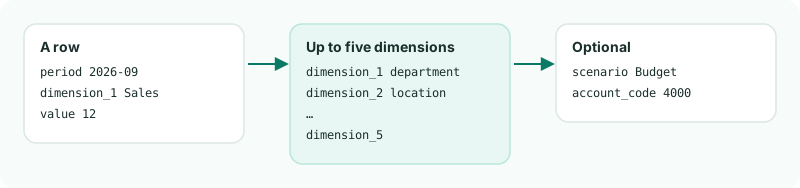
Each row is one figure for one month, described by up to five dimensions - department, location, product, whatever your figure is broken down by. A row is identified by its month, scenario, dimensions and account, so sending the same row again updates its value.
3Send September's headcount
Create Operational.java:
Operational.java
// Operational.java - sends September's headcount by department.
import java.util.List;
import java.util.Map;

public class Operational {
    public static void main(String[] args) throws Exception {
        List<Map<String, Object>> rows = List.of(
                Map.of("period", "2026-09", "dimension_1", "Sales", "value", 12),
                Map.of("period", "2026-09", "dimension_1", "Operations", "value", 8),
                Map.of("period", "2026-09", "dimension_1", "Finance", "value", 3));

        var request = Brizo.written(Brizo.call("POST", "/organisations/" + Brizo.COMPANY_ID + "/operation-data", Map.of(
                "declarations", Map.of(
                        "source_reference", "headcount",
                        "period", "2026-09",
                        "value_basis", "company_base",
                        "rate_direction", "document_to_base",
                        "base_currency", "SGD"),
                "records", rows)));

        Brizo.show("Headcount", request);
    }
}
gradle -q run -Pmain=OperationalCheck
Headcount: request 100 - 3 created, 0 updated, 0 unchanged, 0 refused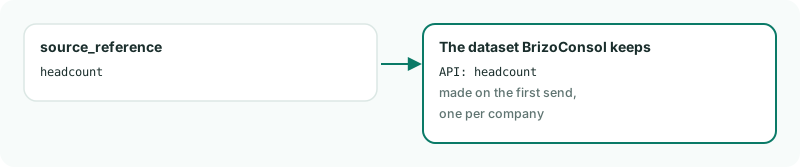
source_reference becomes a dataset of its own, named after it.4The source becomes the dataset
The first send from a source_reference creates a dataset for the company named API: and the source - API: headcount here. Send other figures under other source names, and each becomes a dataset of its own.
5Sending a month again
- Each send replaces this source's figures for the month and scenario: a row you leave out is removed. Send
"mode": "merge"to add and update only. - Figures are kept as you send them; they aren't converted to another currency.
- A company holds up to 1,000 rows a month.
Want more detail? See the documentation